Blog

  • Strategic Technologies for 2009

    Stumbled across this 5 seconds ago:

    1. Virtualization
    2. Business Intelligence
    3. Cloud Computing
    4. Green IT
    5. Unified Communications
    6. Social Software and Social Networking
    7. Web Oriented Architecture
    8. Enterprise Mashups
    9. Specialized Systems
    10. Servers – Beyond Blades

    Will be interesting to watch how this evolves.

  • Portes Ouvertes this weekend

    Last minute pointer:

    Kunstschaffende aus Basel und der Region öffnen alle zwei Jahre an einem Wochenende ihre Ateliertüren, um einem interessierten Publikum Einblick in ihr Schaffen zu gewähren.

    Portes Ouvertes is happening this weekend. Various Basel artists are taking part. A great way to see how artists work.

    Hat tip: Martin Gyger, who is also taking part.

  • From Riehen to Grenzach Wyhlen

    Here are the snapshots of the second architecture tour that I took part in:

    We cycled from Tinguely Museum in Basel and stopped at various points in Riehen and Grenzach Wyhlen.

    Heard about Hans Bernoulli and his Garden City idea to provide improved housing for the working class as well as a patch of ground to grow vegetables and fruit. The wooden houses he built in the Landauer Quartier are apparently still in a good condition. The lease for the Landauer area will expire in 2012 or 2013. And already there are prototypes what this area could look like (mostly high rise buildings and blocks).

    We saw how a small Riehen house from the 1930s was renovated to accommodate for an aging family member in need of medical care and special attention.

    Next, we cycled up the hill and stopped at a couple of Riehen villas before rolling across the border to Germany.

    One building that really stood out was a brand-new gallery/studio building in Wyhlen by Gerner Gerner Plus, an Austrian architectural office.

    The last building of the day was a private house designed by Askari Architekten from Lörrach.

    It was interesting to listen to the owners and architects. It seems that if you really want to build and invest, you also need to become a lobbyist and persuade local authorities and politicians.

  • Appfrica Interview on MTN Uganda

    Just a quick note to point to an interesting interview with an official of MTN Uganda at:

    Appfrica: Interview With MTN’s Erik van Veen – Part 1

    These points caught my eye:

    (…) revenues per user, are very low in Africa by international standards, and require a low cost operating model if the Operator is to be profitable. If you look at East Africa, new customers joining the mobile category spend about $4 per month ”“ that is not a lot!

    (…) I see Asian, especially operators from the sub-continent, playing a bigger role in Africa as they have been able to survive in cut-throat, highly competitive, low tariff environments in their home markets.

    (…) And then you have to deal with the cost of doing business in Africa. Infrastructure and productivity remain major hurdles that add costs to the P&L. Our own success, relative to other companies in most African economies, has backfired on mobile operators in Africa, where governments see these as an easy source of tax income. In East Africa, excise tax (read luxury tax) has been institutionalized within the mindset of financial ministerial policy on tax. Uganda has the 2nd highest tax burden on mobile services in the world, Tanzania 3rd. Just think about it ”“ in Uganda we hand over nearly a third of the cost of every call to the government. What a shame!

    It is a short sighted initiative that is impeding growth of the ICT industry.

    Very interesting read!

    Quick side notes:
    There was a recent article that Malawi is considering to add (or has already added) a 10% tax on all airtime. I can’t find the Daily Times article online any more (note to myself: make a screenshot next time) See this Daily Times article. (Unfortunately this link is broken in the meantime.)

    There’s also White African’s catch phrase to keep in mind.

  • Architecture Tour “Birsstadt”

    As seen previously on my Flickr stream, I stumbled across this poster:

    quoi de neuf

    I took part in two architecture tours this weekend organized by Architektur Dialoge as part of the Les Journées de l’Architectures.

    Birsstadt

    I’ve uploaded a couple of snapshots of yesterday’s tour through Basel-Land. It was “off the beaten track” and lots of fun. During the tour we got a sense of the upcoming challenges as the various municipalities continue to grow and expand from a city planning point of view.

    Today’s tour will have to wait til tomorrow…

  • Tagaroo and other links

    Pêle-mêle off the top my head:

    In my daily reads, I stumbled across a WordPress plugin called Tagaroo. It reminded me of Zemanta. I haven’t tried it out. But I guess the interesting part is that it is being sponsored/developed by media giant Thomson Reuters as part of the Calais project.

    As usual I’ve been taking lots of snapshots. Faves of the week include:

    peek

    the wiring

    Oh and yeah, I know what this year’s Christmas card will look like:

    christmas card 2008

    I tried out some night photography which was a lot of fun. Found out that I’ll need a good, lightweight tripod to pursue this more seriously.

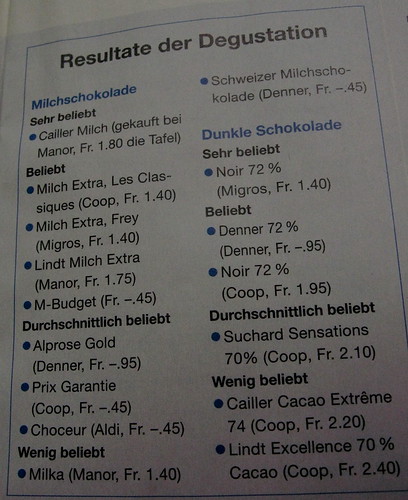
    The Swiss consumer magazine K-Tipp published the results of a chocolate degustazione.

    Resultate der Degustation

    I downloaded hours of video podcasts on CSS.

    African bloggers in Amsterdam:

    Picnic 08 (an annual tech. conference held in northern Europe) had a special Africa track called “Surprising Africa”. There’s a short video featuring the speakers here (via tweet).

  • Zemanta

    I am learning a lot from the African blogs I am reading…

    App+frica recently wrote about useful web applications for bloggers in developing countries.

    In his list he mentions Zemanta:

    Zemanta, which just scored a new round of funding from Union Square Ventures, is a huge time saving tool. It’s a browser-side plug-in that scans the context of your blog posts (even as you’re writing it) and offers up a ton of time saving shortcuts like related links, photos, wikipedia articles, blogposts and suggested tags. With the click of a few buttons it can help you format your post in a way that normally takes hours! For instance, if you’re writing an article about Google, Zemanta will find recent articles about Google from other blogs, photos, logos and more.

    It works with all the major blog platforms including WordPress, Livetype, Blogger, Drupal and more. When I had an abundance of time (and internet) I would usually just do all those things myself but Zemanta speeds up that process significantly.

    Zemanta analyzes your text and then searches the web to suggest related articles, photos, tags. For some texts, the results still need tweaking. But this is a cool tool and a sign of what’s coming.

    Thanks App+frica for sharing. I hadn’t heard of it before. And I live in a so-called developed country.

  • Mulanje

    I just surfed through lots of cool new photos in the Malawi group on Flickr.

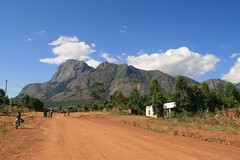
    Including these photos of Mulanje mountain by Lisa de Vreede:

    Mulanje

    Mt Mulanje

  • Useful CSS and WordPress Links

    For future reference:

    Useful links on CSS and WordPress which I know I’ll lose if I don’t write about them here in my virtual notebook.

  • Freeconomics

    Interesting background article, for future reference:

    We can start with a simple user question: why would we ever pay for anything that we could get for free? When anyone buys a version of something they could get for free, what are they purchasing?

    From my study of the network economy I see roughly eight categories of intangible value that we buy when we pay for something that could be free.

    In a real sense, these are eight things that are better than free. Eight uncopyable values. I call them "generatives." A generative value is a quality or attribute that must be generated, grown, cultivated, nurtured. A generative thing can not be copied, cloned, faked, replicated, counterfeited, or reproduced. It is generated uniquely, in place, over time. In the digital arena, generative qualities add value to free copies, and therefore are something that can be sold.

    Source: Edge: BETTER THAN FREE By Kevin Kelly. Via Appfrica.

  • Useful Mac Tool: Skitch

    It’s been one year and one month since I moved to Mac. And in line with the underlying concept of this post, I’d like to recommend a Mac OS tool which I find very useful:

    Skitch

    If you have a look at my Flickr stream, I tend to post a number of screenshots to collect ideas and illustrate blog posts. Skitch is great for this.

    I found that Skitch is more intuitive than Apple’s Grab. By default Grab creates TIFFs, which I find more cumbersome to handle and an overkill for quick notes.

    I like the Skitch annotation features (text, arrows, circles, squares). This helps to interact with external contractors much faster. And I can easily send the screenshot via Apple Mail.

    I post to my Flickr account directamente without a detour to Flickr Uploader. And Skitch keeps a history of recent photos and screenshots, which I can easily drag to a desktop app like Powerpoint.

    A productivity tool to consider!

  • The RSS Footer

    One of my regular Google alerts currently points to a blog that is scraping entire sections of my content and displaying these on a Blogspot site.

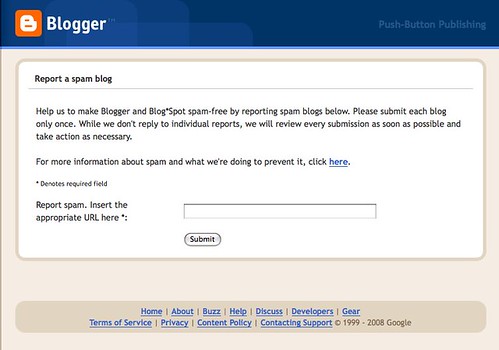
    I have reported the Blogspot site via this website:

    Blogger Help

    And I’m well aware of the fact that anything I publish on the world wide web is up for grabs. It’s a well-known fact. The minute you offer an RSS feeds, scrapers can easily pull your content and display it anywhere they like.

    And you depend on the big search engine company to sort out the original from the copycats.

    That’s why I like this tagline: “Make the scrapers work for you!”.

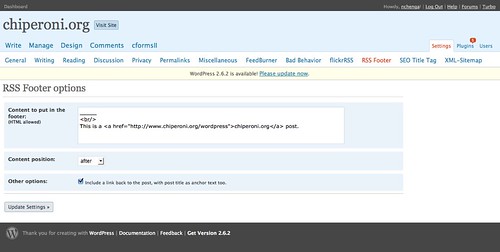
    If you’re using WordPress, download the plugin and upload it to your plugin folder. Activate it in the Plugins view and then open Settings > RSS Footer to add a text and backlink:

    chiperoni.ch › RSS Footer Configuration — WordPress

    Click Update Settings.

    Finally, ping Feedburner (if you’re using it) and you should see the changes show up in your feed.

    If you’re using Blogger (and you understand German), see Mlle. A.’s excellent tutorial.

    See also:
    How to foil scrapers on your blog
    The Lifecyle of a Blog Post

  • Where were you seven years ago?

    When I was a kid, my mom told me that she’ll never forget where she was when she heard that John F. Kennedy had been assassinated. She was at a train station waiting for a train to arrive, when suddenly the news spread that JFK had been killed.

    I’ll never forget where I was when I heard about 9/11. I was at work in Lugano in an open-plan office, a typical Dilbert-like office setting. A work colleague came by and said something to the effect that the USA was being attacked. Various Internet news websites such as CNN or Yahoo were down. A colleague and I headed downstairs to the pub to see if we could find a TV. But somehow the satellite receiver wasn’t set up. So we headed back into the office.

    On the second floor, somebody hooked up a PC, a TV reception card and an online projector. And everybody sat there watching.

  • Swiss Peeks

    Just a link to support a great Flickr project:

    Swiss Peeks is a series of books of photographs taken in Switzerland. The books, published twice each year, contain photographs by amateur and professional photographers alike, which have been shared online and submitted specifically for inclusion in the books.

  • Developers under NDA

    I heard about the iPhone SDK NDA for the first time this week while talking to an iPhone app developer at my day job:

    Why Apple keeps its iPhone 2.0 SDK under NDA

    incredible…

  • My BlogCamp Switzerland Talk

    As announced on Twitter, I presented a talk on mobile technology in Malawi at today’s BlogCamp in Zurich to share what I’m learning from the African blogs and tweets that I follow on a regular basis.

    I started my talk with a short intro on Chiperoni (I am a bridge blogger somewhere between Basel and Blantyre) and why I blog. How much I appreciated Alex Antener’s news stream published on a Polytechnic server during the last Malawi general election. Then pointing to White African’s blog post discussing Twitter’s decision to discontinue its SMS service to the rest of the world. I tried to point out the potential a “Twitter to SMS” service could have for Malawi, where most of the population does not have access to the internet or even a plain old fixed telephone line.
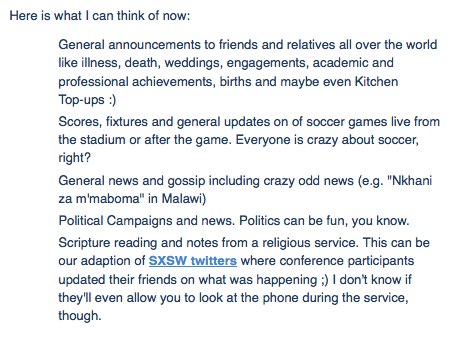
    Soyapi Mumba's Blog: The Potential of Twitter in Africa

    I described the current situation. And how this is changing with mobile technology. I pointed to Mike McKay’s blog post about a rural area in northern Malawi where villagers climb an ant hill to get a better signal.

    In Switzerland we take a lot of things such as the excellent infrastructure we have for granted.

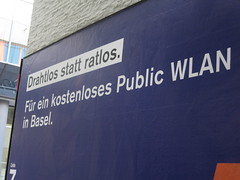
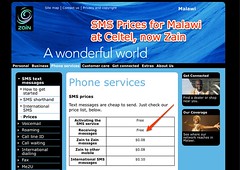
    I shared some of my observations from my recent holiday in Blantyre, some data on the pricing models and how public wifi is being introduced in urban areas.

    tnm || always with you

    Zain Malawi - SMS text messages - Prices

    I was a little shaky on the stats side of things, telecommunication regulations, as well as who owns the major cell phone service companies, TNM and Zain. I’ll need to do more research here. I might have got some of my facts mixed up.

    I did refer to the new airtime tax that is being introduced.

    Examples referred to:

    This talk was inspired by White African’s and Soyapi Mumba’s tweet streams. Zikomo kwambiri. Keep on tweeting.

    Flickr credits: White African, Hackerfriendly, all other photos are my own.

    Big zikomo to Persillie and Mlle A. for reviewing my slides!

    I enjoyed presenting very much (note to myself).

    Oh and I forgot to mention my chat with a Limbe internet cafe manager during the talk…
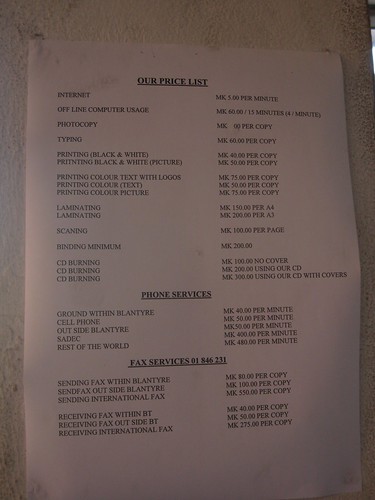
    Limbe Internet Cafe

  • Mobile Communication for Rural Health Project

    I stumbled across this blog by Josh Nesbit discussing the use of FrontlineSMS, a tool to set up a text-based communications network, in a rural health project in Namitete, Malawi.

    Here’s a 7 minute long interview with one of the community health worker. At about 3:00 she starts discussing the advantage of having a cell phone:

    And here’s an interview with Alexander Ngalande, a nurse at St. Gabriel’s Hospital in Namitete, regarding his experience with FrontlineSMS:

    He now uses SMS to communicate with the community health workers to coordinate his medical visits to remote villages. Previously he required a motorbike to send a message when he would be in attendance.

    Examples of text messages being sent:

    – A man missed his appointment with a TB officer. A CHW was texted, who reported the man had gone to Zambia for a funeral. The hospital will be notified upon his return.

    – An HIV support group met, and decided on new member guidelines. Via SMS, the group leader asked the hospital to print copies for the lot.

    – A CHW asked about ferrous sulfate dosages, so he could administer the proper amount to an anemic child.

    We take this type of communication between medical staff and patient for granted.

    See also this BBC article.

  • Art Attack

    Here are the details of the art show that Martin Gyger mentioned when I visited his workspace a couple of weeks ago:

    Art exhibition 5th to 7th September in Basel

    Date: 5th to 7th September 2008,
    Time: Friday and Saturday from 17:00 to 20:00, Sunday from 15:00 to 18:00,
    Place: Reichensteinerstr. 14, 4053 Basel, map.

  • Orchard of old varieties


    i went a-photowalking and learned about a project that is collecting and growing old varieties of fruit.

    alte obstsorten

    berner rose

  • Twitter, SMS and Africa

    This recent Twitter announcement is disappointing on a personal level, but also on a more global level as White African discusses:

    Twitter represents a change in communication. By acting as a global gateway for updates via SMS (or the web), that then updates all of your followers, Twitter succeeded in breaking ground in one-to-many messaging. There have been a couple times over the past year where Twitter was used in Africa to get news out that wasn’t possible in any other format.

    And in the comment thread he explains:

    What’s missing for it to work in Africa is not just the sending of updates, but the receiving of your contacts updates. That really is what created the network effect for Twitter, and why it can’t succeed where it’s not available.

    In Africa, not having SMS is a deal killer. Though there would undoubtedly be users who access it through the web – as is true throughout the rest of the world, true penetration in Africa can only come through services that can be fully operational using only SMS. Why I think this is particularly disappointing is that those third generation Twitter services that could really serve the needs of both ordinary Africans and humanitarians globally will not be built now.

    The really interesting thing to me, so that Twitter doesn’t have to shoulder the load by itself, is the opportunity to build services that are separate and independent, but also equal. I guess the closest analogy I have would be to Jabber in this case – where anyone can run a server and that makes the whole greater than the sum of it’s parts.

    A very interesting thread, which I’d like to recommend here.

    My observations in Blantyre:

    • Despite the relative high cost, nearly everybody has a cell phone.
    • The top present to get for your girlfriend is a cell phone (!).
    • Most people use prepaid cards. See the current tariff plans at Zain (previously Celtel) and tnm.
    • Cell phones are helping to connect remote places, that never had a telephone connection. Villagers can hear more often and directly from family members that have moved to the cities or emigrated to SA, the USA and other countries. Farmers can compare market prices, receive weather updates. See Cy’s video.
    • Internet services are relatively expensive. Out of reach for personal use. Connecting via fixed line is slow and error prone. The way forward is wifi. Despite these encouraging developments, Internet will remain out of reach for most people for many years to come.

    IMG_1890