Category: tech

  • RSS Feeds

    Here are a couple of links in preparation for a meeting tomorrow where I get to explain how I use RSS feeds.

    What is an RSS Feed?

    There’s a video explaining RSS feeds in plain English:

    How do I use RSS feeds?

    1. To follow niche topics: to keep up with news and topics that I am interested in. My advice: don’t subscribe to any high-volume news feeds like CNN or the BBC. Use it to stay up-to-date on topics that you are following regularly, e.g. I’ve subscribed to a number of websites that write about technology in Africa.
    2. As a single-source input base with endless distribution possibilities: I can distribute and cross-reference items  on other websites of mine using RSS. For example, I can display my latest Chiperoni.ch entry at another website and vice versa.  WordPress, the web technology I use at this site,  offers RSS feeds for comments, categories and tags. For example the RSS feed address for entries categorized as Malawi is: http://www.chiperoni.ch/wordpress/category/malawi/feed/
      This is a simple but great way to make a website more dynamic. See also my recent prototype.

    Advantages versus a regular email newsletter:

    • I can easily unsubscribe a feed, if I want (less hassle than email newsletter).
    • I can decide in what intervals I would like to receive updates.
    • I can choose where I want to read a feed (in a desktop reader, in my email inbox or in web-based tool).
    • I can subscribe to an RSS feed via email.

    Tools:

    I currently use Google Reader, a web-based feed reader. I have used dedicated desktop feed readers, other web-based tools, and the feed reader of Mozilla Thunderbird and Apple Mail. My preferences change from time to time. A web-based reader has the advantage of being accessible where ever I have Internet access and a browser. Email clients are great for a corporate environment.

    More on Google Reader:

    I can share, email or tag an entry within my RSS reader:
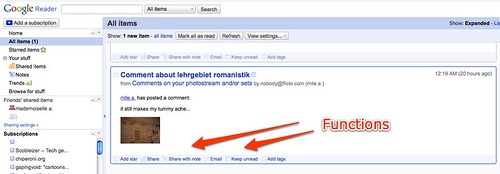
    Google Reader (1)

    What else? Feel free to comment and describe your usage, while I catch some sleep.
  • SMS for Rural Health Service in Malawi

    Before I rush into my busy day:

    CNN has published an article on Josh Nesbit’s project at St. George’s in Namitete, Malawi. I wrote about the project here and talked about it at BlogCampSwitzerland.

  • Text Snippets Circling Around

    Pêle-mêle off the top of my head:

    Learnt yesterday:
    The number of English-speaking Internet users is decreasing, currently at about 35% of total number of Internet users.

    Shared yesterday:
    Who writes about African technology developments? From the list, I follow White African, Afrigadget, and sometimes Google Alert points me to IT News Africa.

    Photo processing software for Ubuntu:
    I’m currently MacBook-less (there are plans to change this very soon), but in the meantime I’ve installed Ubuntu 8.04 on an Acer Aspire 5920. I tried upgrading to Intrepid Ibex, but I couldn’t get my LAN connection to work. Something to do with the MTU count. And I encountered 2 bugs during the install:

    • package update-manager 1:0.93.32 failed to install/upgrade: ErrorMessage: SystemError in cache.commit(): E:Sub-process /usr/bin/dpkg returned an error code (1), E:Sub-process /usr/bin/dpkg returned an error code (1)
    • package ubuntustudio-menu 0.9 failed to install/upgrade: there is no script in the new version

    So I went back to Hardy Heron. Cost: most of my Saturday. Learning effect: priceless.

    I’ve been scanning the Internet for Linux photo processing software, besides Gimp, Picasa and F-Spot. ‘Cos so far Canon’s DPP has not been ported to Linux. I guess I could use it via Wine. But between you and me, I’m just looking for a good excuse to get a new MacBook. Beyond that DPP (still) lacks a good straightening tool.

    I tried BlueMarine ‘cos it sounded promising, but I quickly gave up. Not usable.

    There are a couple of commercial tools to consider:

    • LightZone Linux
    • Bibble

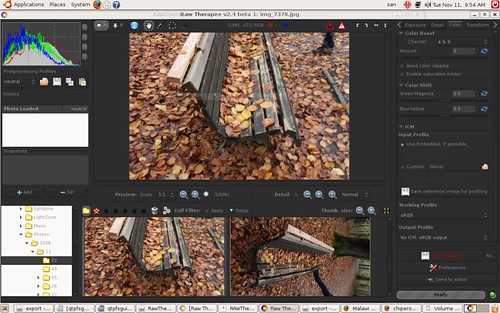
    In the end I tried Raw Therapee and downloaded Qtpfsgui for HDRs. Both of which are free and look promising at this stage.

    Screenshot

    BTW, this blog post is good example how I can trick myself into writing a longer text. Initially, I just wanted to write a few Tweet-like text snippets, a summary of various small items circling around in my head. Pêle-mêle off the top of my head.

    Please feel free to comment. I would be very grateful for any Ubuntu tips and tricks, etc.

  • Opening .MHT Files on a Mac

    Executive summary:
    Best tool to open .mht files on a Mac is Opera for Mac.

    I regret deleting Windows Vista.

    Last week I was sent a .mht file. And now I’m searching the Internet for a solution how to open this proprietary Microsoft file (my perception, but according to Wikipedia it is actually a proposed standard).

    MS Word 2004 for Mac said something like this “is not a valid archive”.

    I found this forum entry at Mac OS Hints.

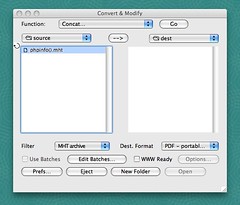
    The GraphicConverter way didn’t work for me. Only a small graphic file displayed. The rest of the content did not display. BTW, I’m not too fussed about GraphicConverter anyway. Maybe you use GC, if you only want to extract the images…

    Convert & Modify

    I’d recommend the Stuff It Expander way:

    1. Get the free version of Stuff It Expander and install it.
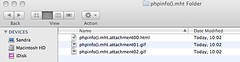
    2. Drag and drop the .mht file to the Stuff It Expander. Stuff It will create a folder with the same name as your file. Within this folder, there’ll be several files with the endings 00, 01, 02, etc. The first of these files is usually the .html file, while the following are image files.
    3. Add the ending .html to the file labeled 00 and open with your standard browser… é voilà . Funziona.

    phpinfo().mht Folder

    Another (probably simpler) way is to get File Juicer.

    The easiest way to read .mht files is to install Opera on your Mac. Open the file to see the contents directly. No further renaming or converting required.

    Opera browser: Home page

    Executive summary:
    Best Tool = Opera for Mac

  • On Following Tweet Streams

    I recently talked to Persillie on the difficulty of following people’s tweet streams. Esp. if you have a limited time budget and can only tune into Twitter every so often.

    For example, I follow Kathy Sierra’s stream at Twitter. You can see quite a few of her 140 character statements in my Twitter Favorites.

    Re: “PR is Dead?” meme–PR has same issue as UI design: it’s NOT something you can slap on afterward. Must be baked into product.

    “Job happiness” should not have a single point of failure… but too often it ALL depends on your current boss. Bad managers REALLY suck.

    Things Smart People Do: Martin Fowler (software dev pioneer) said he went to a ‘passionate users’ talk *because* he “doesn’t like the topic”

    Powerful template 4 learning: “I will do Project A, to ‘force’ myself to learn Skill B” rather than “I must/will learn Skill B” @hrheingold

    PR/marketing should fail when it’s about “getting word out”. If they’re about helping “users kick ass”, we’re good. Less pitch, more teach.

    I see a huge overestimation of the importance of “social” in marketing/PR or product dev in general today.

    etc, etc…

    The difficulty arises when other Twitterers ask questions and Kathy responds. I don’t see the question and it gets much more difficult to follow.

    Twitter is like a cocktail party. The music is so loud, sometimes you only hear parts of the answer.

    Are there Twitter tools that help with this? The only tool I can think of is Twitter Search (formerly Summize).

  • Techniques for Reviewing a User Interface

    I like this quote:

    The GUI is the only contact the user has with the application.

    that I found in this presentation:

    which I found while surfing thru my Sitemeter stats.

    An obvious fact. Yet…

    When talking to software developers, I often hear complaints about the quality of code (especially if somebody else programmed the app). While I understand that wild, unruly code creates maintenance problems and is more error prone, I would expect the same care, investment and commitment on the GUI level. At the very least.

    See also Leah Guren’s presentation at In Other Words on “It may be GUI…”.

  • Strategic Technologies for 2009

    Stumbled across this 5 seconds ago:

    1. Virtualization
    2. Business Intelligence
    3. Cloud Computing
    4. Green IT
    5. Unified Communications
    6. Social Software and Social Networking
    7. Web Oriented Architecture
    8. Enterprise Mashups
    9. Specialized Systems
    10. Servers – Beyond Blades

    Will be interesting to watch how this evolves.

  • Appfrica Interview on MTN Uganda

    Just a quick note to point to an interesting interview with an official of MTN Uganda at:

    Appfrica: Interview With MTN’s Erik van Veen – Part 1

    These points caught my eye:

    (…) revenues per user, are very low in Africa by international standards, and require a low cost operating model if the Operator is to be profitable. If you look at East Africa, new customers joining the mobile category spend about $4 per month ”“ that is not a lot!

    (…) I see Asian, especially operators from the sub-continent, playing a bigger role in Africa as they have been able to survive in cut-throat, highly competitive, low tariff environments in their home markets.

    (…) And then you have to deal with the cost of doing business in Africa. Infrastructure and productivity remain major hurdles that add costs to the P&L. Our own success, relative to other companies in most African economies, has backfired on mobile operators in Africa, where governments see these as an easy source of tax income. In East Africa, excise tax (read luxury tax) has been institutionalized within the mindset of financial ministerial policy on tax. Uganda has the 2nd highest tax burden on mobile services in the world, Tanzania 3rd. Just think about it ”“ in Uganda we hand over nearly a third of the cost of every call to the government. What a shame!

    It is a short sighted initiative that is impeding growth of the ICT industry.

    Very interesting read!

    Quick side notes:
    There was a recent article that Malawi is considering to add (or has already added) a 10% tax on all airtime. I can’t find the Daily Times article online any more (note to myself: make a screenshot next time) See this Daily Times article. (Unfortunately this link is broken in the meantime.)

    There’s also White African’s catch phrase to keep in mind.

  • Tagaroo and other links

    Pêle-mêle off the top my head:

    In my daily reads, I stumbled across a WordPress plugin called Tagaroo. It reminded me of Zemanta. I haven’t tried it out. But I guess the interesting part is that it is being sponsored/developed by media giant Thomson Reuters as part of the Calais project.

    As usual I’ve been taking lots of snapshots. Faves of the week include:

    peek

    the wiring

    Oh and yeah, I know what this year’s Christmas card will look like:

    christmas card 2008

    I tried out some night photography which was a lot of fun. Found out that I’ll need a good, lightweight tripod to pursue this more seriously.

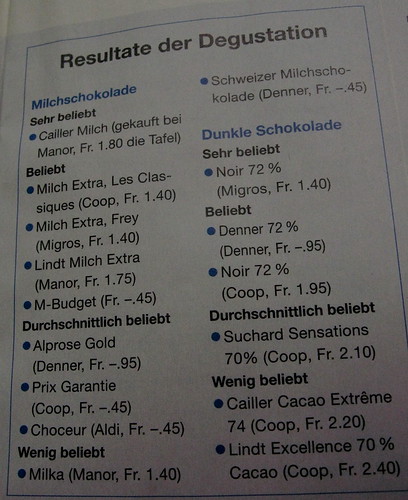
    The Swiss consumer magazine K-Tipp published the results of a chocolate degustazione.

    Resultate der Degustation

    I downloaded hours of video podcasts on CSS.

    African bloggers in Amsterdam:

    Picnic 08 (an annual tech. conference held in northern Europe) had a special Africa track called “Surprising Africa”. There’s a short video featuring the speakers here (via tweet).

  • Zemanta

    I am learning a lot from the African blogs I am reading…

    App+frica recently wrote about useful web applications for bloggers in developing countries.

    In his list he mentions Zemanta:

    Zemanta, which just scored a new round of funding from Union Square Ventures, is a huge time saving tool. It’s a browser-side plug-in that scans the context of your blog posts (even as you’re writing it) and offers up a ton of time saving shortcuts like related links, photos, wikipedia articles, blogposts and suggested tags. With the click of a few buttons it can help you format your post in a way that normally takes hours! For instance, if you’re writing an article about Google, Zemanta will find recent articles about Google from other blogs, photos, logos and more.

    It works with all the major blog platforms including WordPress, Livetype, Blogger, Drupal and more. When I had an abundance of time (and internet) I would usually just do all those things myself but Zemanta speeds up that process significantly.

    Zemanta analyzes your text and then searches the web to suggest related articles, photos, tags. For some texts, the results still need tweaking. But this is a cool tool and a sign of what’s coming.

    Thanks App+frica for sharing. I hadn’t heard of it before. And I live in a so-called developed country.

  • Useful CSS and WordPress Links

    For future reference:

    Useful links on CSS and WordPress which I know I’ll lose if I don’t write about them here in my virtual notebook.

  • Developers under NDA

    I heard about the iPhone SDK NDA for the first time this week while talking to an iPhone app developer at my day job:

    Why Apple keeps its iPhone 2.0 SDK under NDA

    incredible…

  • My BlogCamp Switzerland Talk

    As announced on Twitter, I presented a talk on mobile technology in Malawi at today’s BlogCamp in Zurich to share what I’m learning from the African blogs and tweets that I follow on a regular basis.

    I started my talk with a short intro on Chiperoni (I am a bridge blogger somewhere between Basel and Blantyre) and why I blog. How much I appreciated Alex Antener’s news stream published on a Polytechnic server during the last Malawi general election. Then pointing to White African’s blog post discussing Twitter’s decision to discontinue its SMS service to the rest of the world. I tried to point out the potential a “Twitter to SMS” service could have for Malawi, where most of the population does not have access to the internet or even a plain old fixed telephone line.

    Soyapi Mumba's Blog: The Potential of Twitter in Africa

    I described the current situation. And how this is changing with mobile technology. I pointed to Mike McKay’s blog post about a rural area in northern Malawi where villagers climb an ant hill to get a better signal.

    In Switzerland we take a lot of things such as the excellent infrastructure we have for granted.

    I shared some of my observations from my recent holiday in Blantyre, some data on the pricing models and how public wifi is being introduced in urban areas.

    tnm || always with you

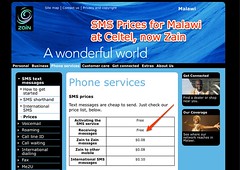
    Zain Malawi - SMS text messages - Prices

    I was a little shaky on the stats side of things, telecommunication regulations, as well as who owns the major cell phone service companies, TNM and Zain. I’ll need to do more research here. I might have got some of my facts mixed up.

    I did refer to the new airtime tax that is being introduced.

    Examples referred to:

    This talk was inspired by White African’s and Soyapi Mumba’s tweet streams. Zikomo kwambiri. Keep on tweeting.

    Flickr credits: White African, Hackerfriendly, all other photos are my own.

    Big zikomo to Persillie and Mlle A. for reviewing my slides!

    I enjoyed presenting very much (note to myself).

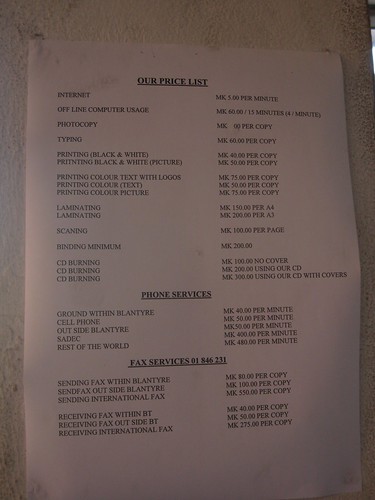
    Oh and I forgot to mention my chat with a Limbe internet cafe manager during the talk…

    Limbe Internet Cafe

  • Twitter, SMS and Africa

    This recent Twitter announcement is disappointing on a personal level, but also on a more global level as White African discusses:

    Twitter represents a change in communication. By acting as a global gateway for updates via SMS (or the web), that then updates all of your followers, Twitter succeeded in breaking ground in one-to-many messaging. There have been a couple times over the past year where Twitter was used in Africa to get news out that wasn’t possible in any other format.

    And in the comment thread he explains:

    What’s missing for it to work in Africa is not just the sending of updates, but the receiving of your contacts updates. That really is what created the network effect for Twitter, and why it can’t succeed where it’s not available.

    In Africa, not having SMS is a deal killer. Though there would undoubtedly be users who access it through the web – as is true throughout the rest of the world, true penetration in Africa can only come through services that can be fully operational using only SMS. Why I think this is particularly disappointing is that those third generation Twitter services that could really serve the needs of both ordinary Africans and humanitarians globally will not be built now.

    The really interesting thing to me, so that Twitter doesn’t have to shoulder the load by itself, is the opportunity to build services that are separate and independent, but also equal. I guess the closest analogy I have would be to Jabber in this case – where anyone can run a server and that makes the whole greater than the sum of it’s parts.

    A very interesting thread, which I’d like to recommend here.

    My observations in Blantyre:

    • Despite the relative high cost, nearly everybody has a cell phone.
    • The top present to get for your girlfriend is a cell phone (!).
    • Most people use prepaid cards. See the current tariff plans at Zain (previously Celtel) and tnm.
    • Cell phones are helping to connect remote places, that never had a telephone connection. Villagers can hear more often and directly from family members that have moved to the cities or emigrated to SA, the USA and other countries. Farmers can compare market prices, receive weather updates. See Cy’s video.
    • Internet services are relatively expensive. Out of reach for personal use. Connecting via fixed line is slow and error prone. The way forward is wifi. Despite these encouraging developments, Internet will remain out of reach for most people for many years to come.

    IMG_1890

  • CSS Editors Reviewed

    for my own future reference:

    Here’s a list of CSS editors that might be useful. Some of them have been around for years:

    Review of CSS Editors

    I use Textwrangler to code HTML and CSS. I recently stumbled across an HTML editor called Smultron, which I quite like as well.

  • Upgraded to WordPress 2.6

    A message from the admin: Chip moved to WP 2.6.

    If anything appears broken, leave a comment 😉

    Update:

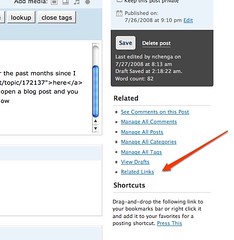
    Finally, fixed the Terong Related Links plugin, which hasn’t been working for the past months since I upgraded to WP 2.5. I found this fix here and simply replaced the PHP code as described. After activating the plugin, open a blog post and you should see a Related Links in the right-hand sidebar below Related.

    chiperoni.ch › Edit — WordPress

    I’m trying out a new plugin called XML Sitemap Generator for WordPress.

  • fring-fring

    in my mailbox:

    Hi there,

    You recently registered to get fring, but sadly your phone was not supported

    Well , good news, the wait is over, and weÂ’re delighted to now invite you to join the fring community!

    Caution: short techie bit coming up…

    Until now, phones running on Java ME software (for example lots of cool Nokia & Sony EricssonÂ’s) have not been able to be part of fring because the technology of these devices is very different from the others in the fring family. One of the main differences is that they handle voice calling in a very specific way that makes it difficult for fring voice to be included.

    …end of Techie bit!

    So, in response to literally thousands of potential Java ME fringsters wanting to become part of our growing global community, weÂ’ve created a special version just for you called minifring, enabling you to connect with other fringsters and all of your online communities from your mobile for free and enjoy the benefits of being part of fring.

    With minifring you can now use some of the most popular bits of fring to keep in touch with all of your other fring, Skype, GoogleTalk, MSN, AIM, Yahoo, ICQ, and Twitter, buddies, for free while youÂ’re on the go. You can enjoy the same rich IM-style chat, and real-time presence as other fringsters, so youÂ’ll know at a glance whoÂ’s available, whoÂ’s in a call, and whoÂ’s already chatting. YouÂ’ll see all of your online buddies and phone address book contacts in one convenient searchable list. And youÂ’ll be able to send music, picture, video and other digital files easily and quickly from your mobile without the cost or hassle of MMS, Bluetooth, cables or infrared.

    Best of all, youÂ’ll be able to experience for yourself what fringing freedom is all about!

    Just as with fring, you can connect over any mobile internet connection – 3G, WiFi, Edge, GPRS (and soon WIMAX) And it doesnÂ’t matter which mobile network operator youÂ’re a member of – all you need is a data subscription, and weÂ’ll give you fring.

    And if you get a phone in the future which supports fringÂ’s voice calling, you can seamlessly transfer and enjoy the full fring experience without any hassle.

    To join up, simply visit www.fring.com, click the Download button and follow the step-by-step instructions and youÂ’ll be a fringster before you know it!

    We look forward to welcoming you to the family.

    The fring team.

    Sounds interesting. And it’s good timing. Cos a lot of people are now talking about mobile apps.

    hmm… I can’t find my Sony Ericsson W810i in the list.

    (the apostrophes showed up like this in my mail = authencity)

  • More CVS commands for humble MarComm folks

    (for future reference)

    To remove a tag and file:

    cvs tag -d "tagname" filename

    cvs remove -f filename

    cvs commit -m "message" filename

    To tag an entire folder:

    cvs tag -F "tagname" foldername

    I started using command line cvs more frequently. These are reminders for myself. In addition to the cvs help.

  • Is the blog hype over?

    Today I* was asked:

    Is the blog hype over?

    My answer:

    Yes, the hype is over, but blogs are still around and will not disappear any time soon. In my humble opinion, blogs are becoming more and more mainstream (read “boring” for all of those geeks looking for the next big wave).

    Reasons:

    • I no longer need to explain the term “blog” as often
    • The Web 2.0 party crowd has moved to Friendfeed and Twitter and similar services
    • (i’ll try and think of more reasons tomorrow…)

    There’s a lot of people that read blogs, but don’t know it’s a blog from a technical point of view. For them it’s a dynamic website with frequent changes.

    Some blogs are evolving into new media outlets, a lot are serving niche purpose like providing an easy and fast way to get the news out on a specific, dedicated topic.

    There are people in “old school” PR and marketing that are starting to adopt blog software, as well as journalists that use blogs to enhance their online presence. A sign in itself.

    There’s the SEO aspect and the regular stats mining that blog technology has made more accessible than in Web 1.0 times.

    But, obviously a lot of people have noticed that creating a good blog is hard work. Blogging isn’t an easy way to get rich quick. At least not in Switzerland.

    *As somebody that jumped onto the blog bandwagon early on, I guess I’ve evolved into an expert of sorts. I’m curious what blogs will eventually develop into.

    I believe that individual blog sites or collaborative, mini social networks (formerly known as home pages) will remain attractive, cos I control and determine what happens on my own site (cf advertising, server downtime, centrally controlled maintenance, data ownership) instead of some corporation.

  • Searching for a new, versatile WP theme

    I’ve been browsing around (aimlessly) looking at WordPress themes.

    Uploaded a couple and tried them out, but there’s always something that I don’t like. Typography, comments, additional plugins I need to use the theme. After a while I return to my 3 column version of K2.

    What I don’t like are hard-coded navigation or list links.

    I guess, I’m looking for a simple, minimalist theme. Maybe a tumbler kind of layout which focuses on the posts.

    The current short list:

    • Barthelme
    • Bogart
    • MiniBits
    • Grid Focus Public

    (update) I found a theme i like.

  • Scared by my own Tweets

    (introspection)

    Amakhala scared.

    Seeing my own tweets display on my blog is kind of frightening and scary. And has a sci-fi weirdness. I think I’ll deactivate the display of tweets for a while.

    Tweets contain a lot of personal information. And it’s searchable. Let’s see who’s having coffee

    My only consolation: there is such a flood of tweets out there.

    Very tired…