for future reference:
Podcasting: The Beginner’s Guide
If you have any tips on good and inexpensive digital recorders or mics, feel free to drop me a line or leave a comment.
Inspired by Pauline’s podcast interview…
for future reference:
Podcasting: The Beginner’s Guide
If you have any tips on good and inexpensive digital recorders or mics, feel free to drop me a line or leave a comment.
Inspired by Pauline’s podcast interview…
Back from Geneva. Here are a couple of short, offline notes I took during the various sessions.
I don’t want to provide a write-up of the sessions I attended. See Stephanie’s or Bruno’s excellent write-ups instead. And in addition, the LIFT 07 videos and presentations will be available online some time soon.
So here’s a list of concepts / ideas / websites I heard about in my usual bullet-list style, i.e. my “fragments of captured attention”:
Lee Bryant: Collective Intelligence
The next development: joined-up social tools.
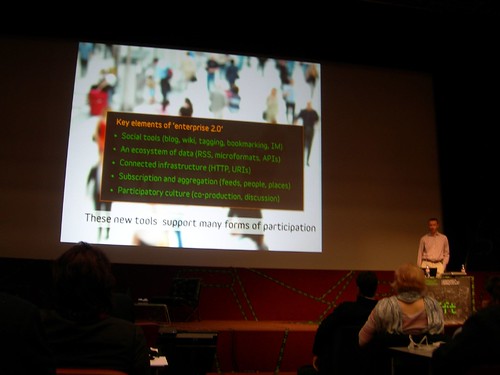
Social Funneling – social reading, writing, filtering and eventually information will find me.
Adoption of social tools in corporations: IT is an issue, there are various perceptions of dangers and risks. The default position should be “open”. Practical advise how to introduce social tools: set up pilot projects with small groups.
Users will generally fall into 3 categories:
It’s not easy to “create” shared content on a company or corporate level.
Stowe Boyd: Social = Me First
The individual is the new group
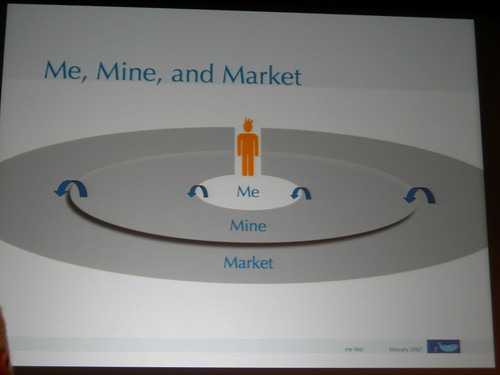
There’s a lot of Web 2.0 companies dying off, because their mindset is exactly inverse. Stowe refers to himself as a software psychiatrist.
Discovery is the primary driver. Things like music, places, people, self. If you’re building an app, you need to keep this in mind. In many apps this is often an after-thought.
Paola Ghillani: What kind of Humanity do we want?
She challenged us to think about the technology of our soul, who we are and what is our purpose.
Profit maximisation vs profit optimisation
Apparently even Swiss producers would like to enter fair trade agreements with Max Havelaar.
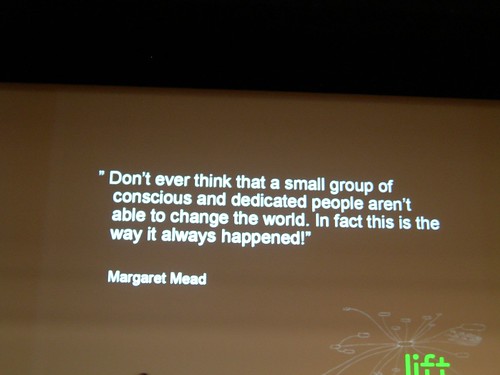
Favorite quote:
Daniela Cerqui: Towards a Society of Cyborgs?
Daniela, anthropologist, interviewed Kevin Warwick and presented her views and findings on RFID tags, etc.
In 2004, night clubs in Rotterdam and Barcelona introduced membership implants instead of membership cards.
In our society, technology is considered a value. It is an ideology. We need to step back and question developments. We’re part of a social context and we’re on the same path. The line between therapeutic use and social convention is easily crossed.
Julian Bleecker: When 1st Life Meets 2nd Life
Julian mapped 1st life to 2nd life games:
Ben Cerveney: The luminous bath: our new volumetric medium
Like Tom, I’ll need some time to reflect and read more on this. Essentially we’re living in a huge bath of data. Media objects or artifacts get meta-tags. Within the bath of data more complex data structures form. There’s some kind of a low-level ability to organise itself. Compare to memotaxis in chemistry.
Aggregate morphologies = mashups
Decanting – take some part of the meta-data
Crstallize – form crystal of data flow which melts away when no longer required
Acculturate – simulate and iterate various paths of evolution applied to different social context.
The data already has an existence of its own. Previous AI models were too abstract…
Adam Greenfield, Everyware: Further down the rabbit hole
The downsides and upsides of pervasive computing, which Adam calls everyware.
Huge new possibilities of surveillance and control,
e.g.
There’s an internet toilet in Japan that analyses body wastes. Developed for medical use but the information could very easily be posted to the net.
Inadvertent: Regarding geospatial data, there are times we don’t want everybody to know where we are. If we click the wrong button (by our own mistake), everybody who asks will know.
Unwilling: Buying a sweater with an RFID tag.
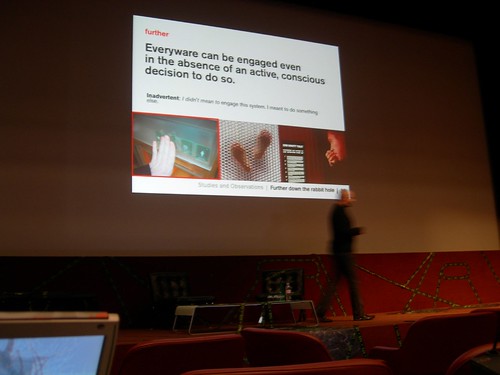
Who do we turn to to get the settings changed and corrected?
Sessions which I didn’t go to, but I wish I had:
Nathan Eagle
Fabien Giradin
Conclusion:
Working in an IT-centered company, I’d like to point out that there’s an important development going on: the rest of the world is using technology and they’re shaping it. Coders and engineers need to adapt and consider the needs of users. It’s no longer their sole domain.
Unlike typical developer conferences with their usual implicit Windows vs Mac, or Sun vs Microsoft/Eclipse/* religion wars, LIFT has a much wider scope and a diverse audience. I met very different people from diverse backgrounds. There was no talk of which blogging tool or platform to use, etc. Instead, it was more about the ways we’re using technology and the impact it will have on society and on us. It was good to get out and reflect on the big picture, the overview.
Other websites to check out:
Digg Swarm
Joost TV / The Venice Project
Magnatunes
Disclaimer: this is my interpretation and view. If I get something completely wrong, please leave a comment 😉
I enjoyed the Lift panel on technological overload. Lots of food for thought. I’m off to grab some coffee.
So far I’m not finding the Open Stage presentations in room 2 very inspiring…
2 more to go before lunch
A small little trend I observed:
Quite a couple of presentations are using Flickr photos as a background…
enjoying my time at Lift 07 and wondering if I’m a candidate for technological overload.
It’s pouring outside and I’m taking a quick moment to publish my unreflected notes that I took in today’s sessions, pêle-mêle, off the top of my head, in shorthand:
Morning session:
The slides are available here.
Evaluating and monitoring projects doesn’t need to be costly, esp. with free web survey and website statistics tools.
Goal is “to prove and improve” website and communication projects.
I liked the way Glenn emphasized the ending of words: “outputt”
Another point I found important: in many projects the emphasis lies on the activities, the processes and the output, instead of the outcome and the impact or goal.
Afternoon session:
In the afternoon I went to Clark Eliott’s workshop on Collaboration and Innovation in Workspace.
Teamwork needs to be reflected in the workspace, but should also offer focus areas if you need to concentrate on a single activity (like writing, coding) and phone booth areas.
People are resistant to change and will come up with thousands of “Yes, but…” Go ahead with the change plans and offer to be on location and change things when disaster strikes.
“Ideas come from everywhere. Share everything you can”
Knowledge workers work on average 9.1 hrs a day.
Knowledge sharing should be rewarded. But often the reverse happens instead, people who withhold or retain knowledge are promoted.
Some ideas how to offer virtual collaboration areas:
Source of stress: arbitrary decisions without communication of the reasons behind them.
Most people go dry and run out of ideas when asked how they would like to improve their workspace.
Discover your work day and then start changing it.
My first workshop at LIFT 07 was great. Enjoyed it. I attended Glenn O’Neil’s D.I.Y. Monitoring and Evaluation….
I’m feeling kind of feverish and I’ve got a bad headache, which is ignoring the Aspirin I’ve already taken.
Bungled reservation, seedy area of town, my Lift conf is off to a flying start from an accomodation point of view….now testing the hotel wifi.
Found this quote in my inbox today:
There is a microscopically thin line between being brilliantly creative and acting like the most gigantic idiot on earth. So what the hell, leap.
by Cynthia Heimel
Summary of this evening’s sporting activities:
A jogging friend noted that so far it has never rained during training time since we started last September. Isn’t that incredible?
Lots of fun. It was incredibly warm for January. Nearly felt like summer.
I’ve uploaded some snapshots at:
http://www.flickr.com/photos/chiperoni/tags/museumsnacht07/
Fun. Today’s roundup of WikiHow links:
What do 200 Calories look like? (BTW, I’d say “do” instead of “does“)
Useful reminder when divs start getting more and more confusing:
CSS Positioning
For future reference:
Eurozine article by Geert Lovink on weblogs
via Bruno Giussani
Like Stefan, I’m looking for a simple way to display my Flickr photos on my website. A couple of weeks ago I had a short look at the tan tan noodles album.

Today I tried out Satellite. It’s a simple php program that connects to your Flickr account. Simple and easy in setup.
There are a couple of little things to improve. For instance, I would prefer if clicking on an image in the photoset sends me to the normal Flickr page instead of the static version.
It’s installed at www.chiperoni.ch/photos/
Alex Antener presents a talk on his Malawi projects:
Freie Software – Eine Chance für Afrika, (in German)
Very interesting, and lots of screens with GNU Linux.
[update] The official recording of the talk is available online.
BBC re-visits Madalitso in Mangochi District:
The small town of Monkey Bay on the banks of Lake Malawi, like so many other small towns and villages throughout southern Africa, is being destroyed by HIV/AIDS. We return to Monkey bay where Joyce Lwanda jumps from class to class struggling to teach an entire primary school on her own. For the children taught by Joyce, head teacher at Kankhande primary School, HIV is both a threat to their lives, and for those lucky enough to avoid the worse affects of the disease it may just take away their best chance at Education. Joyce one of the few teachers that seems to bother to appear at school regularly is HIV positive.
On return to Monkey Bay we also reunite with one of last year’s brightest pupils at Kankhande, Madalitso Mola. Madalitso like so many children in the school is an orphan. One year on, we see how Madalitso’s life has changed, has he too started to show signs of the disease that most likely took his fathers life, is he another one of Africa’s hopefuls lost to HIV?
It discusses the WFP school feeding program and improvements at schools.
If you get a chance to see it, let me know your opinion. I’m sure it will be repeated at various intervals.
I’m viewing BBC World TV on my PC using Zattoo.
The audio lags just a little bit, but the overall quality is good. And it’s live streaming.
There’s a workshop on Dead Media
at the LIFT conf.
What is a liquid?
“Liquids” under the new provisions include:
* Aerosols
* Chocolate spread
* Cream cheese
* Creams
* Deodorants
* Drinks of all kinds
* Foams of all kinds
* Gels
* Hair gel
* Liquid lipsticks (e.g. gloss)
* Liquid mascara
* Liquid/solid mixtures
* Lotions
* Oils
* Pastes
* Peanut butter
* Perfumes
* Roll-on deodorants
* Shaving foam
* Shower gel
* Soft cheeses (e.g. Camembert) and cheese spreads
* Soups
* Sprays
* Syrups
* Toothpaste
* Water
* Yoghurt
* or products of similar consistency
The following items will not be regarded as liquids:
* Chocolate-spread sandwiches
* Hard cheeses (e.g. Edam or Parmesan)
* Peanut-butter sandwiches
* Powders
* Solid lipsticks
* Talcum powder
Seen at Swiss
Interesting:
Overcoming the Digital Divide in Malawi
via Hacktivate