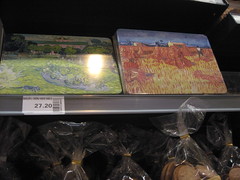
27.20 CHF
Blog
-
Mindblogging
Inspired by lots of fresh air
After lots of hours cramped in front of my books, trying to catch up with my studies, I went jogging for a couple of rounds on the Finnenbahn ( a sawdust track ) in the woods. Usually I find running around in circles boring. But today I didn’t mind cos my head is full of unprocessed data.
And while I plodded around the loop, I thought about:
- Twitter and the Iran election and the video of the dying woman.
- Thoughtless re-tweeting. I find it scary the way people follow others blindly. With good intentions. But without thinking and researching for themselves. I thought of setting up a slogan such as: Think before you re-tweet.
- How the initial design of ARPANET, to compensate for network losses, probably explains why people can still find ways and means to send out tweets and photos and videos out of Iran.
- My Macroeconomics homework about inflation and interest rates.
- The soothing effect the colour of green leaves has on my mind.
The term mindblogging was coined by fellow blogger Persillie and refers to the writing of virtual blog posts while doing something else such as jogging. By default mindblog posts are always better than their written equivalent.
Congratulations to Mlle. A.! Her blog Handmade 2.0 is featured in the current edition of t3n, a German IT and web magazine.
Way to go!
Next in Brand eins?I talked to my mom about internet connections in Malawi. She says that prices for mobile internet are getting more affordable. TNM offers USB modems. I need to research this…
-
Reality Mining
Just confirming what I already knew.
No need to fight against machine-readable passports with RFIDs (c.f. #biometrischer pass). Your regular cell phone (that’s without any fancy GPS functions) already provides all the data needed to track you wherever you go.
c.f. this Namics presentation on Internet trends.
Add some pattern matching with some other online tools and voilà you’re identified.
Some links mentioned in the presentation:
- http://reality.media.mit.edu
- http://blog.namics.com/2005/08/zu_was_handies.html
- http://www.sensenetworks.com
- http://www.pathintelligence.com
- http://www.teltarif.de/arch/2009/kw04/s32689.html
- http://www.car-to-car.org
Wikipedia on Reality Mining:
Reality Mining is the collection and analysis of machine-sensed environmental data pertaining to human social behavior, with the goal of identifying predictable patterns of behavior.
-
The internet is for everyone
Got to love the Internet. Nothing is too obscure.
And a web page for non-twitterers…
Tell the world why you don’t tweet:
http://www.whyidonttweet.com/Buon weekend
-
Test, Test, 1, 2, 1, 2
Looks like my blog is back. Yay.
Missed it. Especially in a time where I feel the return of the personal website is imminent.
Recommended link of the week:
WordnikCan’t wait to try out the new WordPress…
-
Coverage
Compare and contrast 5 years ago to now.
-
On Twitter
Excellent talk.
Presenter Laura Fitton says good content is noticed and forwarded even if there are only a few followers.
Another strength of Twitter is that it supports multi-interfaces and devices. Not limited to a browser.
-
Calculating Present Value
Note to myself. Of no public interest whatsoever.
An exciting topic that is virtually knocking me off my feet.
Present value of a future payment is the amount that one must have today to yield that payment at the future date, given the opportunity rate.
One way to calculate this is to use present value tables.
How much is the present value of receiving 4 million US$ in 6 years at an interest rate of 10% paid at the end of the 6 years?
The present value is calculate (amount received at end of period) * (opportunity rate for 10% and 6 years)-
Equals 4 million * 0.564 = 2.265 million US$If it’s an annuity, i.e. a series of receipts or payments of the same size are received/made at regular intervals, then use present value table for annuities.
For example regular payments of rent 1.4 million US$ at the end of each year for 6 year at an interest rate of 10% have a present value of 1.4 million * 4.355 = 6.097 million $$$.
Alternatively you can use the Excel/OpenOffice function PV:
Syntax:
PV(rate; numperiods; payment; futurevalue; type) -
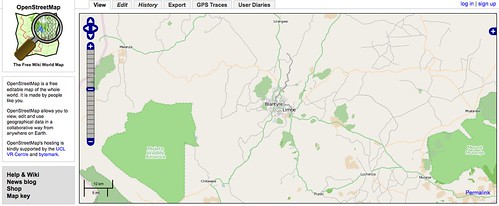
OpenStreetMap of Blantyre
Stumbled across this tweet about Malawi on OpenStreetMap.org.
-
Where are the business models for content?
News of dying newspapers and print magazines have been making the rounds. But also some well-established and respected blogs are closing, or struggling.
Mlle A. of Handmade2.0 recently commented on a design blog’s call for donations:
It’s not just print mags that face hardship. Meaning, blogs that started out with an unpaid version and that are now shooting stars among the design-spotting blogs have a serious problem: keeping up the level and quality, expanding the team AND being able to pay their editors, while at the same time people expect blogs to be completely free of charges. It’ll be interesting to see how this develops.
It’s not just online vs. print. It’s about new business models for content.
More than ever we need good and independent journalists, who have time to research and follow up on stories.
I noticed that some digital photography blogs have been bought by large online shops, e.g. Amazon bought dpreview.com in 2007 and another digital photography blog war recently acquired by a big player. Can’t think of the name. It was mentioned on a TWIP podcast and I remember thinking that it is a great example how content can help drive traffic to a site. Before buying a DSLR I spent a disproportionate amount time on photography equipment blogs.
But what about the less gadget-orientated news? The Watergate kind of journalism. News about local politics in your home town. How will that evolve?
Lots of questions, while I dive into the next chapter of “Principles of Business Economics”.
-
Pirates and Poverty
Like in a Hollywood movie, a U.S. captain was freed from Somali pirates. I’ve been browsing the web, reading articles.
Some observations:
For one, I’m wondering how the navy seals managed to target the pirates. I thought the life boat was an enclosed boat, similar to the one shown here.
Secondly, it seems that the person to call if your ship has been kidnapped is Andrew Mwangura.
The German TV station, ARD lists a quote by him linking piracy and poverty:
Piraten wie die, die bei Phillips Befreiung ums Leben kamen, seien zudem die Fuà Ÿsoldaten im Millionengeschäft mit der Piraterie. Vor allem Jugendliche, die nach 18 Jahren Bürgerkrieg in Somalia jede Perspektive verloren hätten. Auch deshalb ist Mwangura überzeugt, dass die Piraterie vor Somalias Küste weitergehen wird. “Jemanden, der hungrig ist, kannst Du nicht aufhalten. Ein hungriger Mann ist ein wütender Mann. Er wird tun was immer er kann, um ein bisschen Geld zu verdienen, und er wird Risiken eingehen, denn er hat nichts zu verlieren,” ist Mwangura überzeugt.
Sounds like a plausible explanation.
In a BBC article Mwangura explains:
Andrew Mwangura, who runs the Kenyan Seafarers’ Association in Mombasa, thinks that piracy has become a way of life for many young Somali men, as they simply do not know any better.
“All my life, I don’t know what life is, so if someone gives me a gun and tells me to go and make a living, they go and do that,” he said.
Many young men have no education and no understanding of the rule of law.
Somalia has no navy, so many militia groups have taken it on themselves to deal with the problem of illegal fishing.
“Illegal fishing costs Somalia $6m annually and around 800 vessels from around the world are involved,” says Mr Mwangura.
Pirate fisherman provide cheap fish for home markets, Somali pirates support their towns and villages. That raises a key question: is helping your own people good or bad?
Sounds noble. Like Robin Hood.
I think blaming poverty is a way of over-simplifying the situation. As Mwangura states the true beneficiaries of the ransoms are to be found elsewhere, probably in some air-conditioned building, lining their already well-stocked pockets. The pirates are just the foot soldiers. And they don’t know anything different.
Thirdly, the Somali pirates show how vulnerable the shipping business is. And how much our economic systems build on mutual trust.
And finally, this news item reminds me of Proverbs 30:
give me neither poverty nor riches,
but give me only my daily bread.Otherwise, I may have too much and disown you
and say, ‘Who is the LORD ‘
Or I may become poor and steal,
and so dishonor the name of my God.This text sprung to mind. I heard it first in a remote village somewhere in Malawi many years ago.
-
Malawi Cell Phone Numbers Change on April 1
Malawi cell phone numbers have changed:
Zain:
Add 099 and the remaining 7 digits.TNM:
Add 088 and the remaining 7 digits. -
Calling Malawi from Switzerland
Online bookmark:
Check Teltarif.ch for the cheapest telephone rate to Malawi.
Yesterday I couldn’t remember the name of the cheapest Swiss “callthrough” provider… and googling for something like “Billiger telefonieren Malawi” just lists tonnes of German “call-by-call” sites.
BTW, Swisscom costs CHF 1.40 per minute.
-
Better Connectivity for Africa

I really wish this would become reality:
“For me it is so good,” says Sondoto Kobia of Kenya. “I went to sleep yesterday barely being able to get out my emails, but this morning I uploaded a two-hour video of my sons graduation to You Tube in only 10 minutes! I’ve also heard from a number of family members who moved all over the world to places like Spain, France and Washington D.C. The phone is ringing, that’s probably one of them now!”
If only this were real…