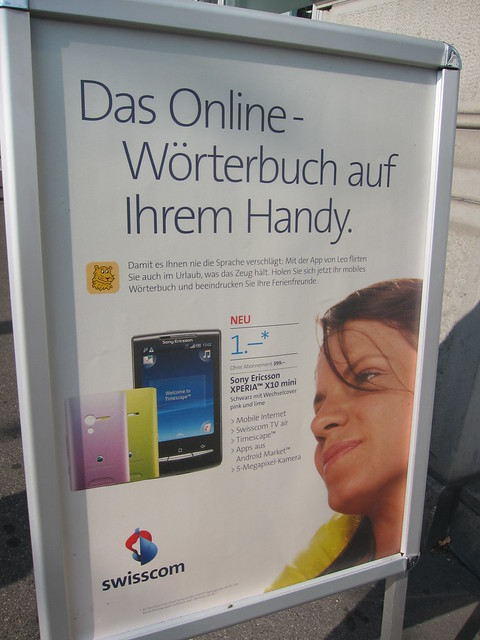
I stumbled across this Swisscom poster showcasing Leo’s mobile app to sell a smart phone:
I started using Leo’s English – German dictionary regularly long time ago – in the late 90s. I think it must have been about 1997 or 1998 at my first full-time job after uni. The vocabulary wasn’t as extensive as it is today. And at the time many people questioned and challenged its reputation as a reference. But, working in an IT company, we had unlimited access to the Internet. And Leo’s website was accessible from every workplace, whereas hard copy dictionaries were few and bulky.
I remember lively discussions with a secondary school teacher for German and English. Her main point was that there was too little information on usage and folks studying English as a second language would be confused and misled by the simple list views. I felt that this also applied to most hard copy dictionaries. Regarding usage I – in turn- recommended Oxford’s monolingual Advanced Learner’s Dictionary.
From early on, Leo offered access to a forum where dictionary users could ask questions, make suggestions, improve dictionary entries, clarify usage, etc. And they added links to other language resources. Which indirectly helped me to find a job during the dotcom downturn.
Well, here I am walking to the office in Züri on a fine, sunny morning… just 13 years later… and Leo is helping to sell smartphones:

Related links:
Leo’s history
Online version of Oxford Advanced Learner Dictionary

P.B. That teacher should have known that regarding proper usage of words, only a monolingual reference is truly useful. But, unfortunately, they often don’t teach how to make proper use of monolingual dictionaries. Because, if we’re honest, many language teachers fail at making proper use of the respective foreign language themselves. Just an observation of years at school and university, talking to fellow language students and having teachers with skills beyond acceptable. 😉
Totally agreed, re: online vs. hard copy. Remember that the only hardcopies we had were the handy “pocket” dictionaries – which, as everyone using dictionaries should know, are not exhaustive at all. They’re good for basics, but not more. Leo, on the other hand, has been continually growing, has been backed by linguists and staff regularly reviewing suggestions for new entries, thus fostering the project to grow and become a one-stop reference for users of all walks of life (though recently, the fora have morphed into a place where students and Azubis are looking for help for having whole sentences for creative writing class translated… obviously without trying to google / leo for solutions first. But that, again, is another sad and sore story all on its own).
Leo is cool. I hope it’ll stay around for a long time.