Blog
-
Malawi photos
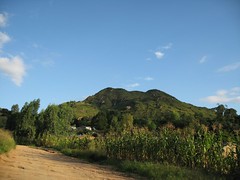
Today’s recommended link: Cy Kuckenbaker’s photos from Malawi:
http://cysfilm.com/The corresponding Flickr album is at:
http://www.flickr.com/photos/cykuck/ -
TED in Arusha
Speaking of conferences, this sounds like an interesting event:
TED in Arusha, Tanzania, June 4-7, 2007
http://www.ted.com/tedglobal2007/program.cfmAnybody interested in sponsoring me in exchange for live blogging? Oh well, too late, registration is closed.
-
BlogCampSwitzerland
I attended today’s BlogCamp in Zurich; a so-called unConference because it organizes itself like BarCamp. But heh, we’re in Switzerland so it was fairly well organized.
I saw a couple of familiar faces. Maybe I should get a t-shirt saying “Blog conference tourist”… And I invited some of the Basel bloggers to the upcoming Basel Flickr group meeting.
Here are some short notes on the talks I attended:
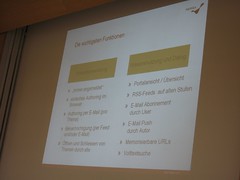
Jürg Stucker showed a knowledge platform they’re using internally at Namics; it’s sort of like a wiki and blog combined with email functionality, i.e. you can post and email an entry at the same time. One of the questions asked was what would happen if it was turned off: Jürg said probably the number of emails would increase and probably some of the fun entries would disappear cos it’s not the kind of information you send around by email. Another question was is there a tool like this available out-of-the-box.
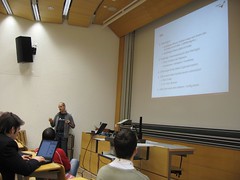
Stephanie Booth talked about multilingual blogging, the pain of translating blog articles, and the technical difficulties of using 2 languages in the same blog. And even in multi-lingual Switzerland, our language skills vary, i.e. we might not feel comfortable commenting in our second or third language. There’s a need to bridge the gap. Her suggestion: Post a short summary to give your readers an idea if this topic is worth ploughing thru or not. Write in a simple and concise style, if you’re addressing a multilingual audience. On the Web, the language barrier is the real separator: Swiss French bloggers look towards France, while Swiss Germans focus more on Austrian or German sites.
benbit gave a live demo how easy it is to hack into a web portal, thanks to XSS and JavaScript. His advice for users: don’t use auto login. Many companies are careless in the way they handle customer data. Even if they are informed about the security hole, no action is taken to secure the site. He suggests getting a tool like RoboForm.
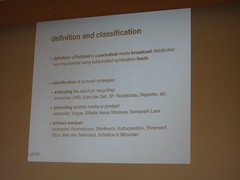
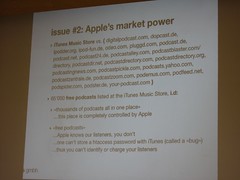
And in the final session, I attended Denis Nordmann’s talk on the future of podcasting. This was an honest overview of the current market situation in Switzerland, which is dominated by public TV and radio broadcasters. Business models based on advertising are difficult to implement, because in general advertisers are interested in regional markets, very few companies advertise globally. And secondly it seems that the big player in this market is somewhat hesitant to fix a “bug” in iTunes which would allow podcast platforms to find out more about their podcast audience, again valuable data for advertisers. Note to myself, check out the podcast platform at: hoerkolumnen.ch
My feedback for the organizers:
I’d prefer one day instead of two, and I think a Saturday is great.Disclaimer: this is my interpretation and view. If I get something completely wrong, please leave a comment 😉
-
Malawi bloggers
When I started blogging back in Jan 2003, one of my high flying and lofty ideas was to help cross the digital divide and point to content about Malawi. A goal I haven’t really managed to keep. But from time to time I’ve pointed to various Malawi sites. It’s great to see that the number of fellow Malawi bloggers is increasing.
There’s:
- Victor Kaonga, currently based in Sweden, raising an interesting question “Is Malawi really poor?”. Victor is also writing about Malawi at Global Voices Online.
- Cryton blogging from the UK about his studies and work and how life in GB compares to Malawi. I like the way he interweaves his texts with Chichewa comments. He’s got an interesting theory regarding soap operas. In my opinion the number of drinking holes is equally high in Malawi.
- And Soyapi visited Yahoo! HQ
- There’s another interesting blog collecting information about Africa’s connectivity.
-
Price comparison

I pay 3.20 Swiss Francs for a kilo of tomato at the local supermarket.
3.20 Swiss Franc is currently about 384.56 Malawi KwachaCompare this to current Malawi prices:
Shoprite 199.99 MK
Peoples 110.00 MK
At the market, between 10 to 50 MK for one tomato depending on its size. -
The power of insects…
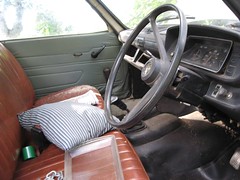
We got to see the destructive power of tropical insects…. One of our cars stood idle for 3 weeks cos it needed to be repaired.
Within those 3 weeks termites got into the seats, started eating away the insulation on the wiring, and created short circuits with their discharge in the fusebox, and thus corroding the contacts.
-
Uploading video
I wanted to upload a 30 sec amateur video of Lake Malawi, file format being AVI, file size 68 MB. I tried YouTube, I tried Revver, but both just show the first 4 seconds and then stop.
The video runs fine on my old Dell. Any tips?
(Update) this is what Revver had to say:
There’s something about this file that our Flash transcoder doesn’t like
(if you click the QT logo below the player you’ll notice that this
version plays all 37 seconds of the clip). It makes sense that the same
thing happened on YouTube since they transcode their movies into Flash
as well.I recommend re-exporting the file as a different file type–possibly a
WMV, and reuploading to the site. -
Reading
I’m currently reading “The Last King of Scotland” by Giles Foden.
See also this BBC report from Kampala
-
Textiles
Here are a couple of snapshots of wall hangings I saw:
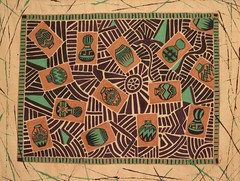

Tribal Textiles, based in South Luangwa, Zambia is making some very nice and original cloth. There’s a shop in Blantyre that has some of their textiles: La Caverna in Mandala House.
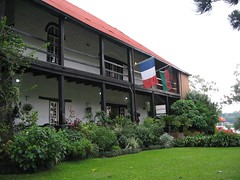
Mandala House is one of the oldest buildings in Blantyre, built by the Moir brothers in 1878. The library of the Society of Malawi is located in the first floor of the same building.
-
Avocados
Here are a couple of snapshots of one of our dogs in Blantyre enjoying avocados:
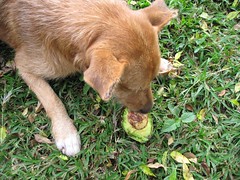
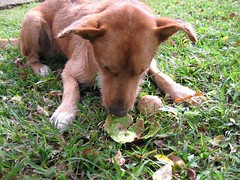
We’ve got an avocado tree in our yard and the dogs eat the fallen fruit.
-
Chiperoni country
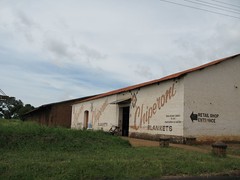
Drive-by snapshot of the Chiperoni blankets depot in Luchenza, Malawi.
See also: http://www.chiperoni.ch/wordpress/index.php?p=9 -
Where we have hope
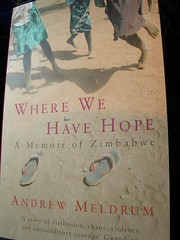
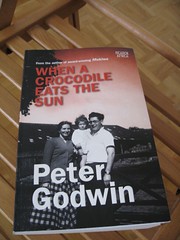
Recommended read: good, informative book on Zimbabwe as seen thru the eyes of a foreign journalist, that was based in Harare from 1980 until he was expelled in 2003.
-
Big Three
Just arrived back in Basel and I’ve got the big three:
Running water
Electricity
Telephone -
Podcasting: The Beginner’s Guide
for future reference:
Podcasting: The Beginner’s GuideIf you have any tips on good and inexpensive digital recorders or mics, feel free to drop me a line or leave a comment.
Inspired by Pauline’s podcast interview…
-
Lift 07: Fragments of Captured Attention
Back from Geneva. Here are a couple of short, offline notes I took during the various sessions.
I don’t want to provide a write-up of the sessions I attended. See Stephanie’s or Bruno’s excellent write-ups instead. And in addition, the LIFT 07 videos and presentations will be available online some time soon.
So here’s a list of concepts / ideas / websites I heard about in my usual bullet-list style, i.e. my “fragments of captured attention”:
Lee Bryant: Collective Intelligence
The next development: joined-up social tools.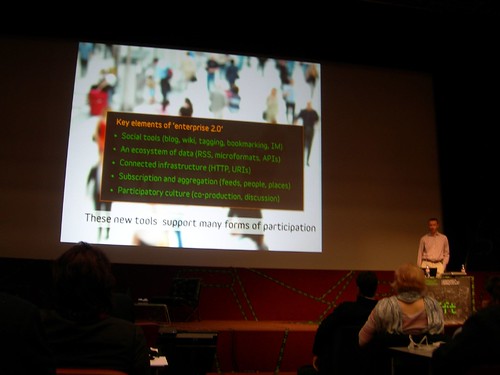
Social Funneling – social reading, writing, filtering and eventually information will find me.
Adoption of social tools in corporations: IT is an issue, there are various perceptions of dangers and risks. The default position should be “open”. Practical advise how to introduce social tools: set up pilot projects with small groups.
Users will generally fall into 3 categories:
- 1% – heavy users
- 10% – synthesizers
- The rest – readers (*not* lurkers)
It’s not easy to “create” shared content on a company or corporate level.
Stowe Boyd: Social = Me First
The individual is the new group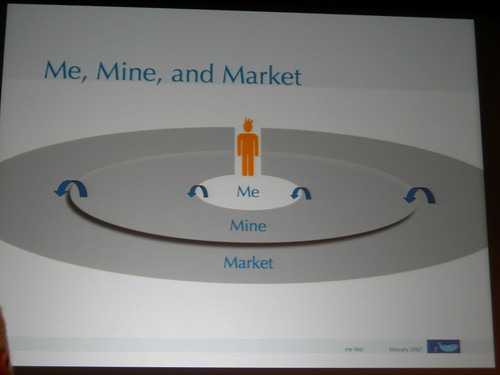
There’s a lot of Web 2.0 companies dying off, because their mindset is exactly inverse. Stowe refers to himself as a software psychiatrist.
Discovery is the primary driver. Things like music, places, people, self. If you’re building an app, you need to keep this in mind. In many apps this is often an after-thought.
Paola Ghillani: What kind of Humanity do we want?
She challenged us to think about the technology of our soul, who we are and what is our purpose.Profit maximisation vs profit optimisation
Apparently even Swiss producers would like to enter fair trade agreements with Max Havelaar.
Favorite quote:
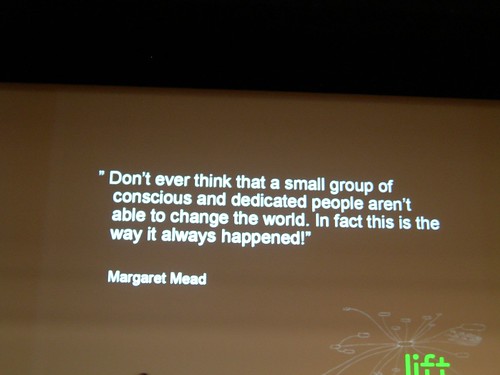
Daniela Cerqui: Towards a Society of Cyborgs?
Daniela, anthropologist, interviewed Kevin Warwick and presented her views and findings on RFID tags, etc.In 2004, night clubs in Rotterdam and Barcelona introduced membership implants instead of membership cards.
In our society, technology is considered a value. It is an ideology. We need to step back and question developments. We’re part of a social context and we’re on the same path. The line between therapeutic use and social convention is easily crossed.
Julian Bleecker: When 1st Life Meets 2nd Life
Julian mapped 1st life to 2nd life games:- Motion: Nintendo Wii
- Time: Animal Crossing for Nintendo DS
- Distance: Teku Teku Angel, virtual pet pedometer
Ben Cerveney: The luminous bath: our new volumetric medium
Like Tom, I’ll need some time to reflect and read more on this. Essentially we’re living in a huge bath of data. Media objects or artifacts get meta-tags. Within the bath of data more complex data structures form. There’s some kind of a low-level ability to organise itself. Compare to memotaxis in chemistry.Aggregate morphologies = mashups
Decanting – take some part of the meta-data
Crstallize – form crystal of data flow which melts away when no longer required
Acculturate – simulate and iterate various paths of evolution applied to different social context.The data already has an existence of its own. Previous AI models were too abstract…
Adam Greenfield, Everyware: Further down the rabbit hole
The downsides and upsides of pervasive computing, which Adam calls everyware.
Huge new possibilities of surveillance and control,
e.g.- Identifying approaching person by their characteristic foot steps and blocking access to building, or
- Identifying a dangerous area (e.g. high murder rate) in the city will influence our behaviour.
There’s an internet toilet in Japan that analyses body wastes. Developed for medical use but the information could very easily be posted to the net.
Inadvertent: Regarding geospatial data, there are times we don’t want everybody to know where we are. If we click the wrong button (by our own mistake), everybody who asks will know.
Unwilling: Buying a sweater with an RFID tag.
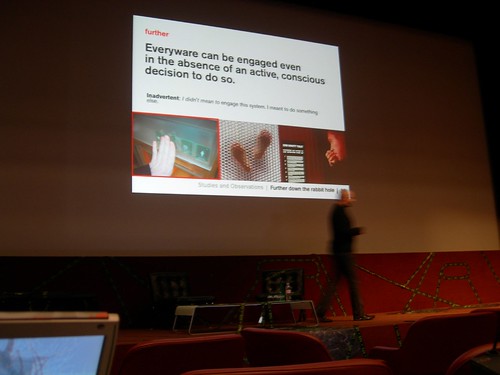
Who do we turn to to get the settings changed and corrected?
Sessions which I didn’t go to, but I wish I had:
Nathan Eagle
Fabien GiradinConclusion:
Working in an IT-centered company, I’d like to point out that there’s an important development going on: the rest of the world is using technology and they’re shaping it. Coders and engineers need to adapt and consider the needs of users. It’s no longer their sole domain.Unlike typical developer conferences with their usual implicit Windows vs Mac, or Sun vs Microsoft/Eclipse/* religion wars, LIFT has a much wider scope and a diverse audience. I met very different people from diverse backgrounds. There was no talk of which blogging tool or platform to use, etc. Instead, it was more about the ways we’re using technology and the impact it will have on society and on us. It was good to get out and reflect on the big picture, the overview.
Other websites to check out:
Digg Swarm
Joost TV / The Venice Project
MagnatunesDisclaimer: this is my interpretation and view. If I get something completely wrong, please leave a comment 😉
-
Overload ( Day 2.75 )
I enjoyed the Lift panel on technological overload. Lots of food for thought. I’m off to grab some coffee.
-
Lift update ( Day 2.5 )
So far I’m not finding the Open Stage presentations in room 2 very inspiring…
2 more to go before lunch
-
Lift ( Day 2.0 )
A small little trend I observed:
Quite a couple of presentations are using Flickr photos as a background… -
Hi from LIFT 07 ( Day 1.5 )
enjoying my time at Lift 07 and wondering if I’m a candidate for technological overload.
-
LIFT conf ( Day 1 )
It’s pouring outside and I’m taking a quick moment to publish my unreflected notes that I took in today’s sessions, pêle-mêle, off the top of my head, in shorthand:
Morning session:
The slides are available here.
Evaluating and monitoring projects doesn’t need to be costly, esp. with free web survey and website statistics tools.
Goal is “to prove and improve” website and communication projects.
I liked the way Glenn emphasized the ending of words: “outputt”
Another point I found important: in many projects the emphasis lies on the activities, the processes and the output, instead of the outcome and the impact or goal.
Afternoon session:
In the afternoon I went to Clark Eliott’s workshop on Collaboration and Innovation in Workspace.
Teamwork needs to be reflected in the workspace, but should also offer focus areas if you need to concentrate on a single activity (like writing, coding) and phone booth areas.
People are resistant to change and will come up with thousands of “Yes, but…” Go ahead with the change plans and offer to be on location and change things when disaster strikes.
“Ideas come from everywhere. Share everything you can”
Knowledge workers work on average 9.1 hrs a day.
Knowledge sharing should be rewarded. But often the reverse happens instead, people who withhold or retain knowledge are promoted.
Some ideas how to offer virtual collaboration areas:
- offer a mashup between online calendars and online map to show where people in distributed teams are currently located
- offer some kind of a company Twitter
- one guy reported that they’re announcing successful or failed software builds using a toy jingle, has become some kind of a team ritual
- identify location of distributed teams using RFID tags
- greet knowledge worker in their personal workspace using RFID tags. RFID tags are cheap and can be used to personalize various settings.
Source of stress: arbitrary decisions without communication of the reasons behind them.
Most people go dry and run out of ideas when asked how they would like to improve their workspace.
Discover your work day and then start changing it.